Holiday rentals
Keyless entry for holiday rentals in Dubrovnik: access control versus smart locks
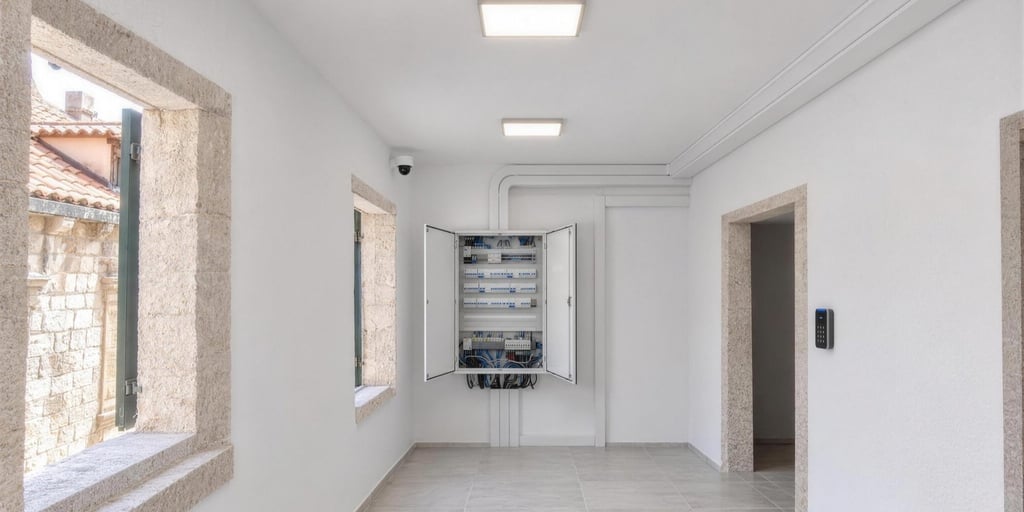
Every guest needs a way in. The Dubrovnik Tourist Board’s report on 2025 lists 4,590 registered hosts with 4,786 properties in household accommodation in the city, which received 480,421 guests during the year. Running a keyless-entry holiday rental takes the key handover out of each arrival, but it does not settle what happens when a battery dies, the internet drops or a code is passed on. This guide compares a standalone smart lock with a wired access-control system (kontrola pristupa).
Smart lock or access control: what is the difference?
A smart lock is a battery-powered lock fitted to one door and opened with a code, a phone or a fob. Access control is a wired system: a card reader (čitač kartica) or keypad beside the door, an electric strike (električni prihvatnik) or electronic lock in the door or frame, and a controller that manages users, times and doors.
| Feature | Smart lock | Access control |
|---|---|---|
| Power | Batteries in the lock | Mains supply to the controller, with backup power where the design calls for it |
| Where it sits | On the door, in place of or over the existing lock | Reader or keypad (šifrator) beside the door, strike or lock in the door or its frame, controller in a cabinet |
| A code for one stay | Where the model supports it | Users with start and end times, where the system allows it |
| Several doors | Each door is a separate device with its own codes | One card or code per person for every door they may use |
| Entry log | In the lock’s app, if the model keeps one | By user and time, across all doors |
| Power cut | Unaffected until the batteries run down | Locked or released by design; backup power, where fitted, keeps it running |
| Fitting | A job on the door itself | Cabling, a power supply and door hardware: electrical work |
What matters day to day is where the power and the decisions sit. A smart lock carries both in the door and relies on the apartment’s internet if you manage it from abroad. Access control keeps them in a controller on mains power, cabled to simple door hardware: more work to install, but it grows from one entrance to a whole building, and it can be linked with a camera at the entrance.
When is a smart lock enough, and when is access control worth it?
A smart lock is often enough for one apartment with its own street door, run by one host. Access control earns its cabling when several units share an entrance or a courtyard gate, when cleaners and maintenance staff need their own codes, or when you want one entry log and one place to manage every door.
Count the doors a guest passes. A studio with its own street door has one; a flat in a block in Lapad or Babin Kuk may have three (the street door, a stairwell door and the flat’s own); a stone house divided into units can add a courtyard gate and a shared laundry. With several doors, each smart lock is a separate device, with its own batteries to change and its own codes to set. Access control gives each person one card, code or phone credential for the doors and hours they may use, keeps one entry log (evidencija ulazaka), and cancels a lost card without a lock change. Where the system allows it, a cleaner’s code can be limited to changeover days.
In a block of flats, the co-owners (suvlasnici) already have a say. Since the 2024 amendment to the Hospitality Act, approval to provide household accommodation needs their prior written consent to short-term rental, and hosts already trading in multi-apartment and mixed residential and commercial buildings have five years to obtain it. A reader on the shared street door changes a door that every co-owner uses, so agree it with the co-owners or the building manager (upravitelj zgrade) first. Inside the Old Town, the City’s Communal Order Decision requires the conservation department’s prior approval for any work on a building’s exterior, so a reader on the street side of a door has to be cleared before it is fitted; electrical work inside the Old Town explains the approvals.
What happens when the power, the batteries or the Wi-Fi fail?
Plan for failure before you fit anything. A battery smart lock works until its batteries run flat, so someone has to act on its warnings between stays. A wired system can be built with backup power, and whether each door stays locked or unlocks in a power cut is decided at the design stage.
With a wired system the choice is made door by door. A strike that stays locked without power (fail-secure) keeps a storeroom shut; one that releases (fail-safe) lets the door open when the power goes. Which one a door gets depends on what it is for and on the safety requirements of the building, so a door on an escape route is not treated like a storeroom door. Backup power in the controller, or a UPS (uninterruptible power supply), carries the system through a short power cut. With a smart lock, ask before you buy:
- How does it open when the batteries are flat, and where is that way in kept?
- Who receives the low-battery warning, and how much notice does it give?
- Do codes keep working when the apartment’s internet is down?
- Can a code be limited to the dates of one stay, and cancelled from a distance?
Either way, the lock has to work for every guest. Croatia’s household-accommodation regulation (NN 9/2016) requires a rental property to ensure safety and functionality, with fittings, equipment and appliances kept permanently in working order, not worn out or damaged; hold a keyless door to the same standard. A wired system also becomes part of the building’s installations, which the Fire Protection Act obliges owners and users to keep in working order, with documentation of that maintenance: keep its papers with the handover documents.
Is a door camera or video intercom covered by the CCTV rules?
Yes, if it can store footage. We found no guidance from AZOP, Croatia’s data-protection agency, that names video doorbells, but its guide for homes treats any camera that can store footage on a memory card, in an app or in the cloud as video surveillance, even when that function is unused. It may cover only your own property.
The rules sit in Articles 25 to 32 of Croatia’s act implementing the GDPR (Zakon o provedbi Opće uredbe o zaštiti podataka, NN 42/2018). A door camera needs a sign, visible at the latest when someone enters the recorded area, saying that the area is under video surveillance (videonadzor), who the controller is and how to contact them to exercise their rights. In a residential or mixed building, co-owners holding at least two-thirds of the ownership shares must consent before cameras go up.
The lens matters as much as the sign. In a 2020 decision on an apartment rental, AZOP prohibited recording by two facade cameras that took in part of a public street and ordered the footage securely deleted within 15 days, although the owner’s sign, 24-day overwrite, password-protected recorder in a locked cabinet and written CCTV rules were all in order. On a narrow Old Town street, a camera above a door looks at public space unless it is aimed and masked with care. Sound is a separate question: AZOP’s guide says that in most cases it finds no legal basis for recording it, so leave a doorbell’s audio recording off.
An entry log records people too, so give access to it only to those who need it. The full camera rules are in CCTV at a rental property in Croatia, and CCTV for homes, rentals and venues describes what we fit.
What does installing access control in a rental involve?
A site visit, a cable route and the door hardware. The reader or keypad goes beside the door, the electric strike or electronic lock in the door or its frame, and a controller with its power supply in a cabinet nearby, cabled to each door. Where cameras or a network are planned, they share the same routes.
The work follows the usual five steps: your description, a site visit (pregled objekta) where needed, a written quote (ponuda) listing labour and materials, the installation with labelled cables, and a handover (predaja radova) where we explain the system. The site visit settles these points:
| Decision | What gets settled |
|---|---|
| Doors | Which doors join the system: the street door, a courtyard gate, each unit, a storeroom or laundry |
| Users | Guests, cleaners, maintenance and the owner, and the doors and hours each may use |
| Credentials | Card, code or phone for each kind of user, and how guests receive theirs |
| Power cut | Locked or released for each door, and whether backup power is fitted |
| Cable route | From the controller to each door, concealed in walls, floors or ceilings, or in surface trunking |
| Handover | Administrator access, the user list and how the system is used, with every cable labelled |
Readers and strikes can share routes with cameras and network cabling, so plan all three at once; Wi-Fi and cabling in stone houses explains where cables can run in a house with thick stone walls. The controller is fed from the distribution board (razvodni ormar), which makes it a good moment to check the board itself, as holiday-rental electrical safety explains.
What should you send for a quote?
Photos of each door from both sides and of its frame, the address or district, the number of units and doors, and who needs to get in besides guests. Say whether there is Wi-Fi or network cabling and whether cameras are planned. We reply with a written quote or a site-visit time.
Send it on WhatsApp, call +385 95 506 8145, write to elektroaccess8@gmail.com or use the quote form. Messages can be sent at any time and are answered Monday to Friday, 07:00–16:00. The readers, keypads and locks we fit are described under keyless entry and access control.
Quick answers
Is a smart lock enough for a holiday apartment?
Often it is, for a single apartment with its own front door and a host who acts on battery warnings and changes codes between stays. Once there is a shared street door or a courtyard gate, several units or a cleaning team with codes of its own, a wired access-control system is usually the easier one to run.
What happens to a keyless door in a power cut?
A battery smart lock keeps working until its batteries run down. A wired system can be built with backup power, and whether each door stays locked or unlocks when the power goes is decided at the planning stage, according to what the door is for and the safety requirements of the building.
Can a guest's code work only during their stay?
Yes, where the lock or the system supports time-limited users. The code or card starts working at check-in and stops at check-out, at the times you set, so nothing is handed over or returned, and a code passed on after the stay no longer opens the door.
Does a camera at the door of a rental count as CCTV?
It does if it can store footage. AZOP, the Croatian data-protection agency, treats a camera that can store footage on a memory card, in an app or in the cloud as video surveillance even if that function is not used. Such a camera may cover only your own property, never the street or a neighbour's door, and it needs a sign that is visible at the latest as people enter the recorded area.