Practical
Storm season on the Adriatic: surge protection and what to do after a lightning strike (DHMZ)
When is storm season around Dubrovnik?
Storms come in every month, but autumn is the busiest season. In the 1971–2000 station normals of the Croatian Meteorological and Hydrological Service (DHMZ), thunder is heard on 50.8 days a year, 15.5 of them from September to November, with October the stormiest month. November also brings more than four times July’s rain.
| What DHMZ records at the city station | Figure | Period |
|---|---|---|
| Days with thunder a year | 50.8 | 1971–2000 |
| Thunder days, September to November | 15.5 | 1971–2000 |
| Thunder days, June to August | 14.0 | 1971–2000 |
| Thunder days in October, the stormiest month | 5.3 | 1971–2000 |
| Rain in July | 32.0 mm on 4 days | 1961–2024 |
| Rain in November | 142.8 mm on 13 days | 1961–2024 |
| Strongest wind gust on record | 44.3 m/s (about 159 km/h), in December | 1961–1990 |
The whole area stands out: DHMZ’s map of thunder days puts the Dubrovnik area in the 40–46-day band, among the parts of Croatia with the strongest thunderstorm activity (the map is smoothed over 40 km blocks, so it reads lower than the station). DHMZ’s climate overview adds that the southerly jugo is stronger and more frequent on the central and southern Adriatic than in the north.
Early-autumn storms can be severe. Ahead of the storm of 10 and 11 September 2025, DHMZ warned of locally more than 100 l/m² of rain in a short time, jugo gusts near 100 km/h and thunderstorms (Dubrovnik Net). After DHMZ’s red warning on 10 September, the City put its emergency and utility services on heightened readiness and warned of possible flooding and loss of power, communications and water (Libero Portal).
How does lightning damage an electrical installation?
Through the cables that run into the building. A lightning discharge carries 10 to 110 kiloamperes for between a hundredth of a second and two seconds, DHMZ explains. A strike on or near the building can push a surge, a brief overvoltage, along those cables into the property, where it can damage the installation and anything plugged into it.
The installation is more than the mains wiring. Croatia’s Technical Regulation for Low-Voltage Electrical Installations also counts the permanent cabling for communications, signalling, control and fire alarms as part of it, while appliances plugged into the installation fall outside its scope. After a storm, the fixed wiring and cabling are a matter for the inspection described below; damaged appliances are repaired or replaced separately.
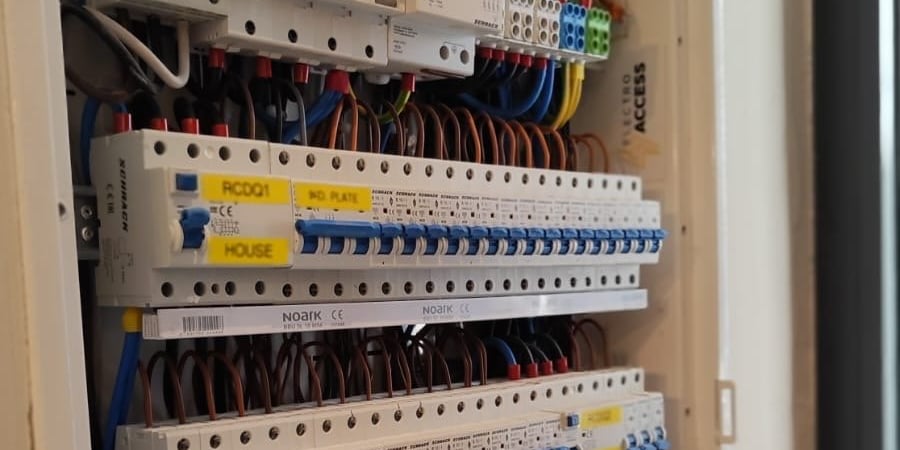
A residual current device (RCD; zaštitna strujna sklopka, FID) in the distribution board (razvodni ormar) switches off when it detects current leaking away, most often through a faulty appliance, damp in the installation or damaged insulation. Tripped devices after a storm show that the protection acted, not why: the cause is found by measurement, circuit by circuit. Why the power trips in summer explains what each device on the board reacts to.
What does surge protection in the board do?
Surge protection (prenaponska zaštita) is a device in the distribution board, connected between the live conductors and earth. In normal use it does nothing; when a surge arrives, it conducts and diverts the surge current to earth, so that far less of it reaches the installation and your appliances. It needs good earthing to do that.
Fitting it is a change to the installation, and the low-voltage regulation requires an extraordinary inspection after every change, so the new device is checked together with the board it sits in. The measurements typically include the earth resistance, the test of the earthing the device relies on.
Surge protection is not a lightning conductor. A direct strike on the building is the job of a lightning protection system (gromobranska instalacija), which has its own regulation and inspection intervals, set out below. Nor does it replace an RCD: the RCD is there to protect people from electric shock, the surge protection to protect the installation and the equipment. Ask, too, whether the aerial, satellite and data cables that enter the building need protection of their own. We fit RCDs and surge protection as part of our power installations work, on new boards and on replacements.
How often must a lightning protection system be inspected?
Croatia’s Technical Regulation for Lightning Protection Systems on Buildings (NN 87/08, amended by NN 33/10) sets the longest gaps between inspections by protection level, which the building’s design fixes: from a yearly visual check and tests every two years at level I to a visual check every two years and tests every six at levels III and IV.
| Protection level | Visual inspection | Tests and measurements | Critical parts |
|---|---|---|---|
| I | every year | every 2 years | every year |
| II | every year | every 4 years | every 2 years |
| III and IV | every 2 years | every 6 years | every 3 years |
The regulation rests on the HRN EN 62305 standards, sets record forms for both kinds of inspection and has the owner keep the documents permanently. The 2025 Building Act keeps it in force, with the 2010 regulation for low-voltage installations, until new rules replace them. Whether a building has a system, and at which level, is set in its design; in a block of flats, ask the building manager (upravitelj zgrade). After a strike on a protected building, have the system checked whatever the interval says.
What should you do after a lightning strike?
Make the property safe first. If you smell burning, see smoke or find scorch marks, switch off the main switch (glavni prekidač) if you can reach it safely, touch nothing hot or wet, and for a fire call the emergency number 112. Then note what tripped and what stopped working, and have the installation inspected before full use.
- Find out whether the cut is yours. If the neighbours have no power either, it is a cut on the distribution network, which HEP ODS, the electricity distribution operator, is responsible for; its Dubrovnik contacts are in our guide to HEP ODS connections.
- Look at the board without opening it. Note which circuit breakers (osigurači) and RCDs have tripped, and take a photo.
- Reset once. A device that trips again straight away, or will not reset, stays off until its circuit has been tested.
- Keep sensitive equipment unplugged until the installation has been checked, use nothing that smells burnt, and list what failed.
- Have the installation inspected and tested.
Croatian rules ask for that last step. The low-voltage regulation requires an extraordinary inspection (izvanredni pregled) after any extraordinary event that may affect the installation’s technical properties or raise doubt about its usability. A regular inspection under it pairs a visual check with measurements to the HRN HD 60364-6 standard (the regulation cites the 2007 edition; the current one dates from 2016), with the results in a test report (zapisnik o ispitivanju), and the record of an extraordinary inspection must hold the same data. The measurements typically cover the continuity of the protective conductors, insulation resistance, fault-loop impedance, an RCD trip test and the earth resistance, none of which a visual check can show.
The same regulation makes the building owner keep the inspection documents permanently, so file the report with your photos and the list of damaged equipment. If the property is let, tell guests where the main switch is and not to reset a device that trips twice; a labelled board makes that call easier, as the handover documents explain.
How do you prepare a property for the storm season?
Do it before September, when the autumn peak begins. Have the surge protection checked and the earthing and residual current devices tested, make sure every circuit is labelled, find out whether the building has a lightning protection system and when it was last inspected, and agree with guests or a caretaker what to unplug when storms are forecast.
Maintenance is also the owner’s duty in law. The Fire Protection Act requires owners, users and building managers to keep electrical installations that could cause or spread a fire in working order, with records of that maintenance, and the 2025 Building Act obliges owners to maintain a building so that its fundamental requirements are preserved. The low-voltage regulation sets regular inspections at least every 15 years for residential buildings and every four years for all other buildings, unless the design or a special regulation sets a different interval.
DHMZ’s lightning page shows strikes detected in the last 30 minutes, a quick way to see whether a storm is close; thunder can be heard up to 65 km away.
To have the board checked on a changeover day or before the season, describe it on the quote form or call +385 95 506 8145. Fault calls after a storm are taken 07:00–16:00, Monday to Friday, and on the call we tell you when we can come.
Quick answers
When is thunderstorm season around Dubrovnik?
Storms come in every month, but autumn is the busiest season. DHMZ's 1971–2000 station normals give 15.5 thunder days from September to November against 14.0 in summer, with October the stormiest month at 5.3 days.
Does surge protection stop a direct lightning strike?
No. Surge protection in the board deals with surges that arrive along the cables. A direct strike on the building is the job of a lightning protection system (gromobranska instalacija), which Croatia regulates separately, with inspection intervals set by the protection level in the building's design.
Why did the RCD trip in a thunderstorm?
A residual current device switches off when it detects current leaking away, most often through a faulty appliance, damp in the installation or damaged insulation, and only measurement shows which. Reset it once. If it trips again at once or will not reset, leave it off and have the circuit tested.
Is an inspection required after a lightning strike?
Croatia's technical regulation for low-voltage installations requires an extraordinary inspection after any extraordinary event that may affect the installation's technical properties or raise doubt about its usability. If a strike damaged equipment or tripped the protection, treat it as such an event and have the installation inspected.
How do I know whether the surge protection still works?
Have it looked at whenever the installation is inspected. Croatia's low-voltage regulation requires each regular inspection to include a visual check that every part of the installation is in proper condition, and an extraordinary inspection after any event that may have affected it. Ask the electrician who fits the device how to tell when it needs replacing.
How often must a lightning protection system be inspected?
It depends on the protection level in the building's design. At level I the regulation asks for a visual check every year and tests every two years; at levels III and IV, a visual check every two years and tests every six.